As an online business owner, finding the best email marketing platform is no easy task. There are so many services out there, each with a different feature set and, of course, a different price tag. If someone asked me in the past which tool to use to get started, my answer was often: Mailchimp.
The popular email marketing platform Mailchimp has a lot of features, is easy to use, and for a long time offered a free plan for the first 2,000 subscribers. But those days are gone. Keep reading to understand why I stopped using Mailchimp and which tools I use instead.
Why Mailchimp is no longer the right email marketing platform
Mailchimp is an email marketing platform with a solid reputation and some handy tools. Like many successful products, however, it comes with a hefty price tag. What made it so attractive for years? The generous free plan, which has been significantly scaled back.
The free tier that once supported up to 2,000 contacts was gradually reduced to 500, then to just 250 contacts, with a monthly sending limit of only 500 emails. In June 2025, Mailchimp removed classic automation features entirely from the free plan. Anyone wanting to send automated welcome emails or drip campaigns now needs to pay from $13/month on top of that, Mailchimp counts unsubscribed and inactive contacts toward your limit, which can drive up costs unexpectedly.
The paid plans are not cheap either. The Essentials plan starts at $13/month for 500 contacts, but scales up quickly as your list grows. For 10,000 contacts you can easily end up paying $75/month or more. For most small business owners and marketers, there are alternatives that offer far better value for money.
Most important features and requirements
Before looking at alternatives, we need to identify which email marketing features we actually need:
- A template builder or template gallery for quick and easy email creation. Two features matter here: a powerful and user-friendly drag-and-drop editor, and the ability to import your own HTML email templates.
- No hard limit on the number of subscribers. None of the well-known systems truly caps subscriber counts, but it is important that you can maintain a list in the database without paying a lot of money.
- The option to use Amazon SES or other SMTP services. Sending via Amazon SES is cheap, fast, and reliable. Many professional email services use Amazon SES to deliver their messages.
- An API, WordPress plugins, and integrations with other systems such as Zapier, to grow your subscriber base and connect the platform to your website and other applications.
- Automatic responders and drip campaigns. Alongside regular campaigns, automated campaigns and responders are essential ingredients for growing your mailing list.
As you may have noticed, this list does not include advanced features like A/B testing. While the selected systems should offer at least some of them, we do not consider them a hard requirement.
What are the best Mailchimp alternatives?
Based on these requirements, we found three Mailchimp competitors that offer almost every feature from our list:
1. EmailOctopus – email marketing for less
The London-based company was founded in 2014 and is a member of the AWS Partner Network. EmailOctopus has grown into a fully-fledged email marketing service with more than 50,000 customers who together send over 19 billion emails annually.
EmailOctopus offers two subscription tiers: a free Starter plan and a paid Pro plan. The free plan includes up to 2,500 subscribers and 10,000 emails per month — a remarkably generous offer compared to most competitors. The paid Pro plan starts at just $10/month for 500 subscribers and scales with the size of your list. With $40 for 10.000 subscribers, EmailOcotpus is much cheaper than Mailchimp!
Compared to its early days, EmailOctopus has significantly expanded its service. Where it was once primarily a simple campaign tool, the platform now also offers:
- Automation (drip campaigns and welcome sequences) on both plans
- Segmentation based on campaign activity (opens and clicks) and custom fields
- A landing page builder with drag-and-drop functionality
- Built-in forms (embedded and pop-up) for collecting subscribers
- Modern, responsive email templates and an intuitive drag-and-drop editor
- Detailed reporting with real-time insight into opens, clicks, bounces, and unsubscribes
- Zapier integration with more than 2,000 platforms, including Salesforce, Shopify, and SurveyMonkey
- API for list and campaign management
- Optional Amazon SES integration (Connect plan) for cost-efficient sending via your own AWS account (the standard plan uses EmailOctopus own servers)
- Don’t forget our own WordPress plugin for EmailOctopus
Cons to keep in mind:
- Automation triggers are relatively limited: no triggers based on email opens or clicks within the workflow editor
- Advanced e-commerce features such as abandoned cart are missing
- No built-in A/B testing functionality
- No multilingual support
- Contacts appearing in multiple lists are counted multiple times
EmailOctopus is an excellent Mailchimp alternative for anyone looking to build their list or who does not expect to manage extremely large audiences. The platform offers all the essential options at a very competitive price. Its support team is known to be responsive and helpful, even for users on the free plan.
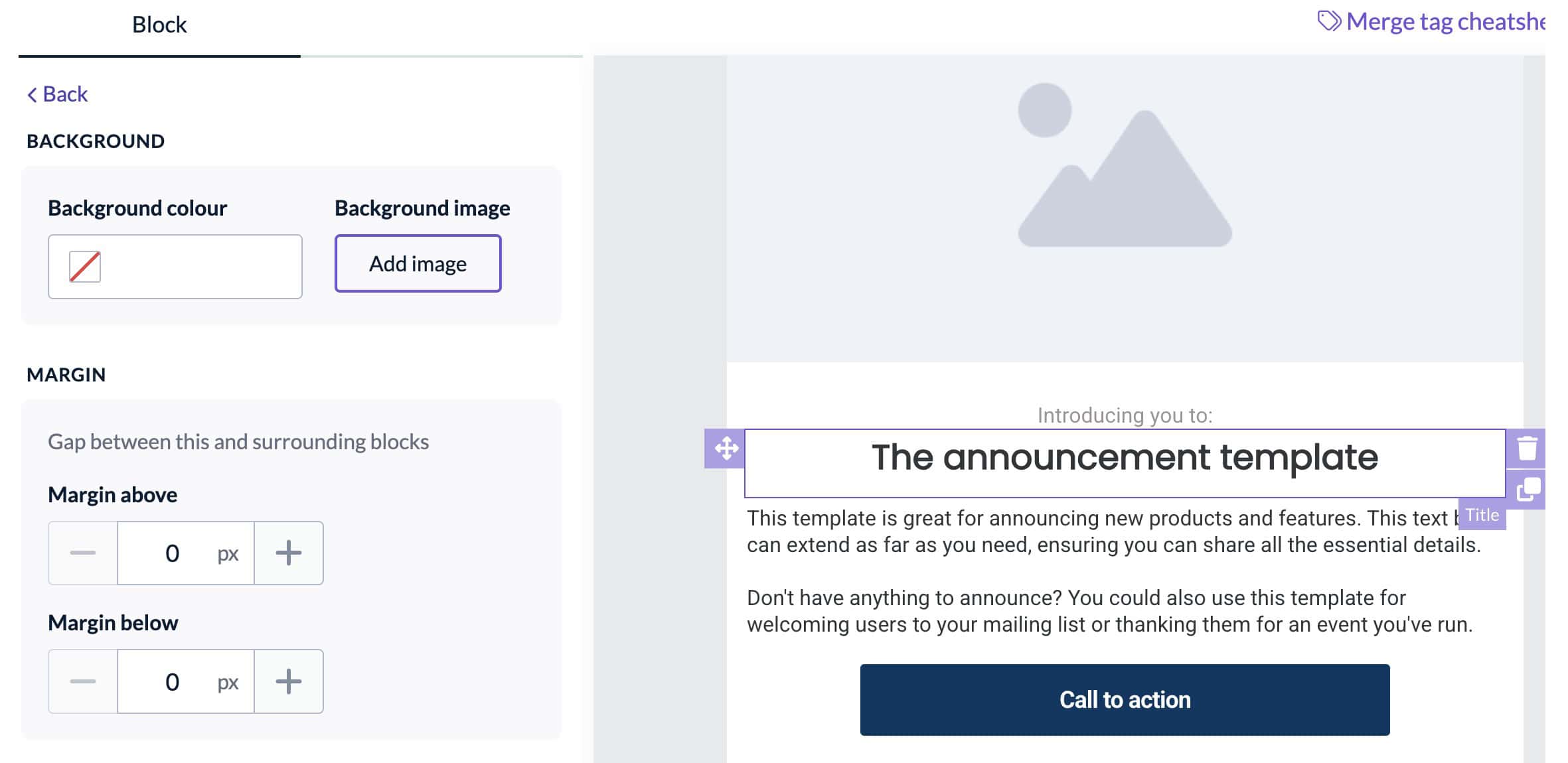
EmailOctopus template editor
2. MailBluster – powerful email marketing via Amazon SES
MailBluster is a cloud-based email marketing platform built on top of Amazon SES — and now also supporting Postmark, Mailgun, and SMTP2GO. The service is trusted by more than 59,000 businesses and email marketers worldwide, and has delivered over 1.7 billion emails to date.
MailBluster operates on a transparent two-tier pricing model. The free Starter plan offers unlimited contacts and up to 3,000 emails — ideal for testing the service. The Pro plan costs $60 per year ($5 per month) plus $0.60 per 1,000 emails sent. SMTP costs from your chosen provider are additional, but via Amazon SES these are exceptionally low.
Features offered by MailBluster:
- Unlimited contacts on both plans
- Drag-and-drop email editor with an extensive template library
- Automation (drip campaigns) on the Pro plan
- Advanced segmentation and contact tagging
- A/B testing for campaigns
- Real-time tracking: opens, clicks, bounces, complaints, and e-commerce conversions
- Double opt-in functionality for high-quality list building
- Support for multiple SMTP providers (Amazon SES, Postmark, Mailgun, SMTP2GO)
- Multiple users and roles per account
- Integrations with WordPress, WooCommerce, Zapier, Salesforce, Zoho, and more
- Powerful developer API
- Custom merge tags for personalized emails
Cons to keep in mind:
- An external SMTP account is always required
- The free Starter plan is limited to 3,000 emails, after which you must upgrade to Pro
- Automation is only available on the paid Pro plan
MailBluster is an excellent choice for anyone who wants to send large volumes of emails at minimal cost. The combination of a $60 annual subscription plus variable sending costs via Amazon SES makes it extremely affordable for high-volume senders. Its extensive integrations mean it fits seamlessly into an existing marketing stack.
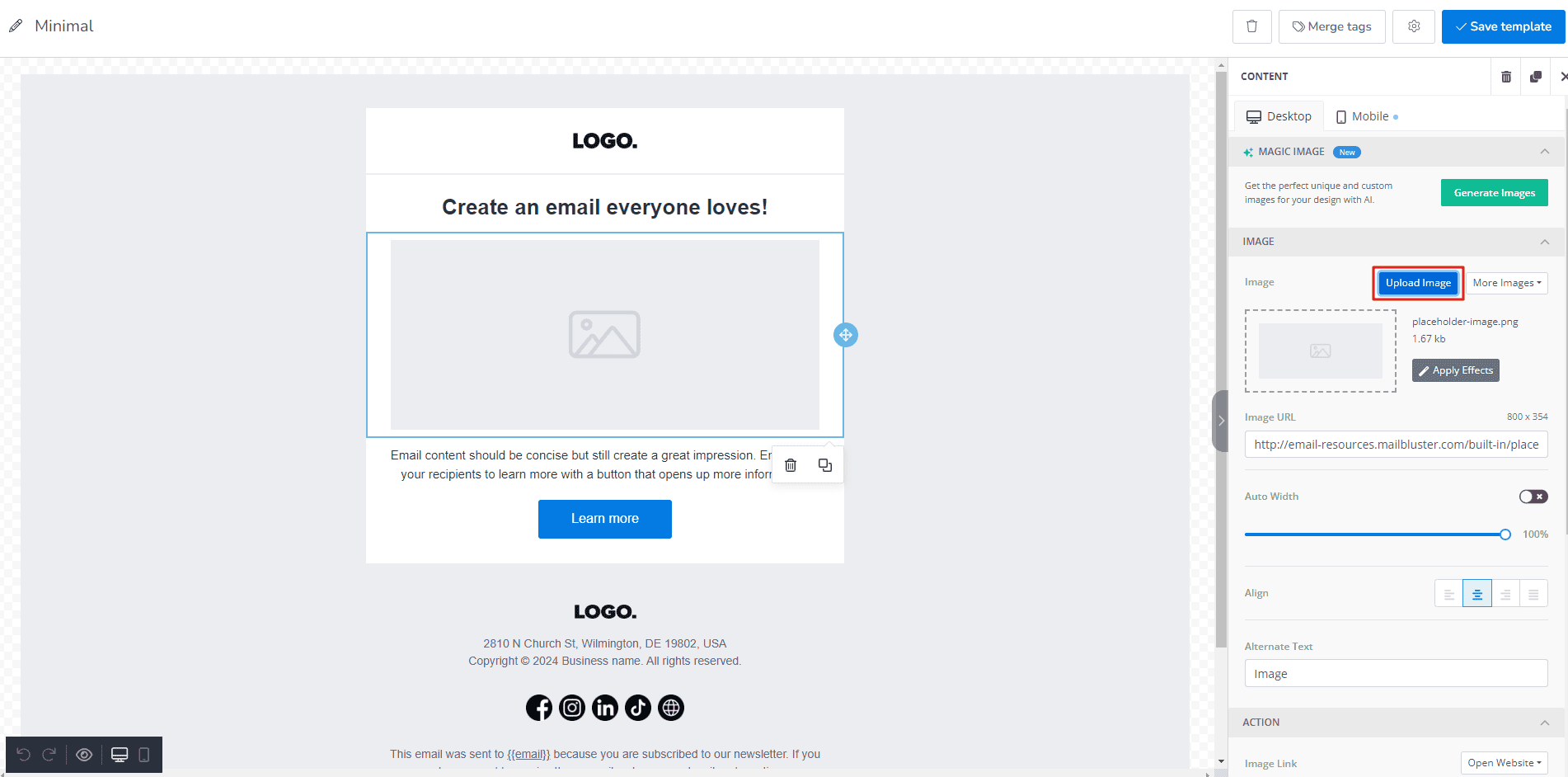
MailBluster Email editor
3. CampaignLark- Simple and Scalable Email Marketing
CampaignLark is a great Mailchimp alternative if you want something that is clean, easy to set up, and doesn’t charge you extra as your list grows. The people who made Maileroo made this modern email marketing platform. It can get you from nothing to sending in less than five minutes, and it doesn’t have the extra features that bigger platforms do.
What sets it apart
CampaignLark sets its prices based on the number of emails sent, not the number of contacts. That’s a big difference from Mailchimp, which charges you for every contact on your list, even if they unsubscribe. It lets you keep as many contacts as you want on paid plans without worrying about your bill going up every time your list grows. The Starter plan costs $15 a month and lets you send 5,000 emails a month. There is also a free plan that lets you send up to 1,000 emails a month to get started.
The platform sends more than a hundred thousand emails every month, and more than 90% of them end up in the inbox. This shows that it is dedicated to deliverability from the ground up. It has an adaptive delivery engine that helps your emails get to inboxes instead of spam folders. This is crucial if you are running campaigns that need to be done quickly and effectively.
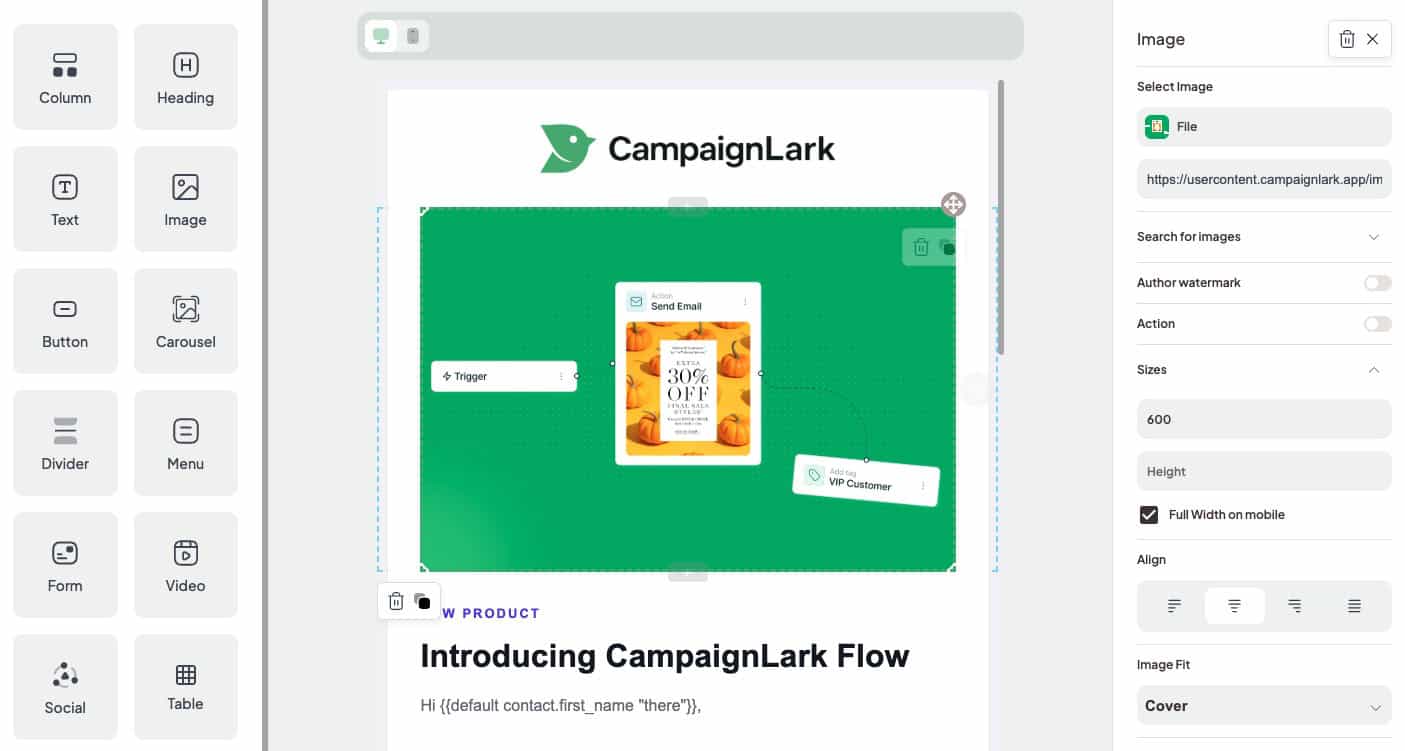
CampaignLark email editor
Key features
- Drag-and-drop email editor (Lark Editor) with a full template gallery, plus support for custom HTML if you want full control
- Behavioral automations that trigger emails based on sign-ups, clicks, inactivity, and more, with multi-step journeys and conditional logic
- Real-time analytics covering opens, clicks, bounces, geographic data, and device/client breakdowns
- Audience segmentation with dynamic segments, custom fields, and contact scoring coming soon
- Isolated workspaces, useful for agencies or businesses running multiple brands, with per-workspace billing and role-based permissions
- A/B testing available on all plans, including the free tier
- API access and incoming webhooks for developers who need to connect it to their stack
Pricing
CampaignLark keeps things transparent. The free plan lets you send 1,000 emails per month to up to 5,000 contacts. It also includes 2 domains and 2 automations. The Starter plan costs $15 a month and gives you 5,000 emails, unlimited contacts, 25 segments, and 15 automations. For higher volumes, tiered plans go up through Growth, Pro, Enterprise Plus, and beyond.
You don’t need a credit card to get started at campaignlark.com.
The pricing advantage of Amazon SES
Mailchimp and many other email marketing services charge a monthly fee for the number of subscribers, regardless of whether you actually send any emails. The Amazon SES pricing model works differently: you pay just $0.10 for every 1,000 emails sent.
The biggest advantage: there are no monthly costs if you do not send any emails. MailBluster work seamlessly with Amazon SES, allowing you to take full advantage of Amazon’s low-cost infrastructure.
Objective advice: which alternative suits you best?
All three tools are affordable, quality Mailchimp alternatives, but they target different needs. Here is an honest evaluation:
Choose EmailOctopus if you…
- are new to email marketing and want to get started quickly
- want a generous free plan for a list of up to 2,500 subscribers
- prioritize simplicity and ease of use over advanced features
- are looking for a budget-friendly solution that scales with your growth
EmailOctopus is the most accessible choice. The free plan is generous, the interface is intuitive, and the customer service has a strong reputation. For small businesses, bloggers, and non-profits, this is the logical first step.
Choose MailBluster if you…
- send large volumes of emails and want to keep costs as low as possible
- already have an Amazon SES account or are willing to set one up
- need A/B testing, advanced segmentation, and real-time tracking
- want the flexibility to choose between multiple SMTP providers
MailBluster is the most cost-efficient choice for high-volume senders. For anyone sending hundreds of thousands of emails per month, the fixed annual cost of $60 plus variable SMTP fees is hard to beat. Perfect for marketers and tech-savvy users who want maximum control at minimum cost.
Choose CampaignLark if you…
- want a clean, modern platform that doesn’t take hours to figure out
- prefer pricing based on emails sent instead of contacts stored
- need built-in automations, segmentation, and real-time analytics without complexity
- manage multiple clients or workspaces and want everything organized in one place
CampaignLark is the balanced choice. It’s powerful without being overwhelming, with a strong focus on usability and predictable pricing. For agencies, growing businesses, and anyone tired of contact-based pricing, it offers a more scalable and straightforward approach to email marketing.
In short:
For anyone who wants to start simply and affordably, EmailOctopus is the best choice. For maximum cost-efficiency at high volumes, MailBluster wins. And for those who want a mix of both, CampaignLark is the strongest option.
Published in: Blogs
